Scaling PEM water electrolysis depends on reducing iridium use without compromising performance, durability, or manufacturability.VSParticle develops highly porous catalyst layers with ultra-low iridium loading, which are deposited directly onto porous transport layers via a dry, binder-free process. This enables more efficient use of iridium, simpler electrode manufacturing, and a scalable pathway toward lower-cost PEM electrolyzers.
What VSPARTICLE enables for PEM electrolyzer OEMs
3
Lower catalyst cost and supply risk
Reduce iridium loading by up to 90%, lowering precious-metal costs and exposure to price volatility and supply constraints.
3
High performance at ultra-low iridium loading
Deliver performance and durability comparable to industrial benchmarks while using substantially less iridium.
3
Improve iridium recovery and recycling
Binder- and ionomer-free catalyst layers make iridium easier to separate and recover, reducing material losses and supporting more circular use of a critical raw material.
3
Overcome CCM scalability
constraints
Dry, binder-free deposition directly onto titanium porous transport layers enables a PTE architecture, avoiding the handling and manufacturing challenges associated with coating increasingly large and thin membranes.
3
Support gigawatt-scale PEM electrolyzer
manufacturing
PTE-ready catalyst coatings are designed for scalable production, helping OEMs reduce iridium dependency, lower system costs and progress toward cost-competitive green hydrogen and DOE 1-1-1 targets.
3
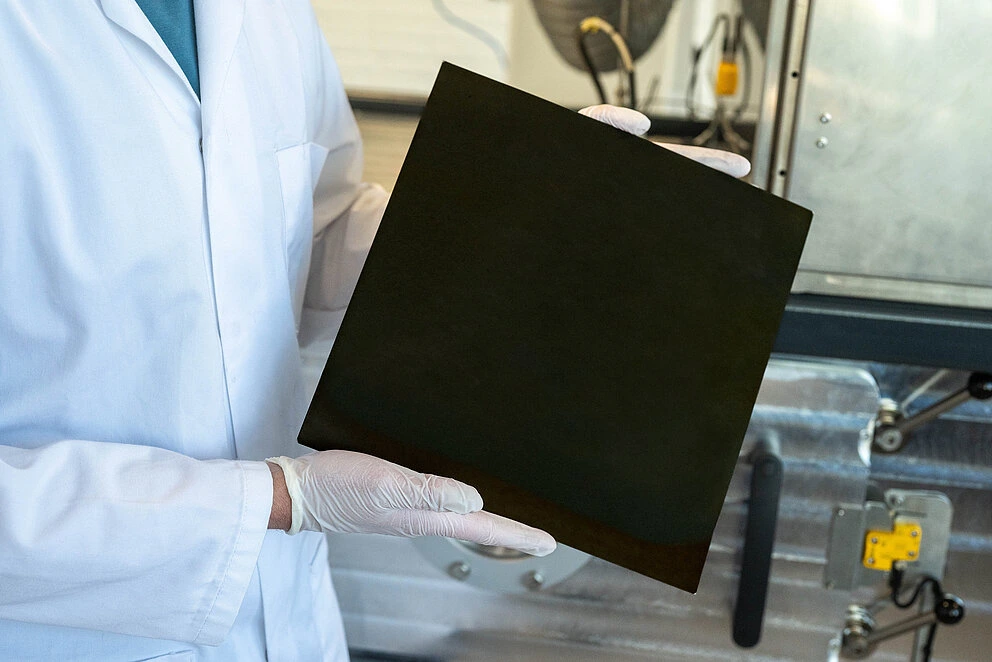
Plug Power: Long-term performance at 0.4 mg/cm²
In collaboration with Plug Power and the Center for Clean Hydrogen, VSParticle catalyst layers with an iridium loading of 0.4 mg/cm² were evaluated for performance and long-term stability under relevant industrial operating conditions.
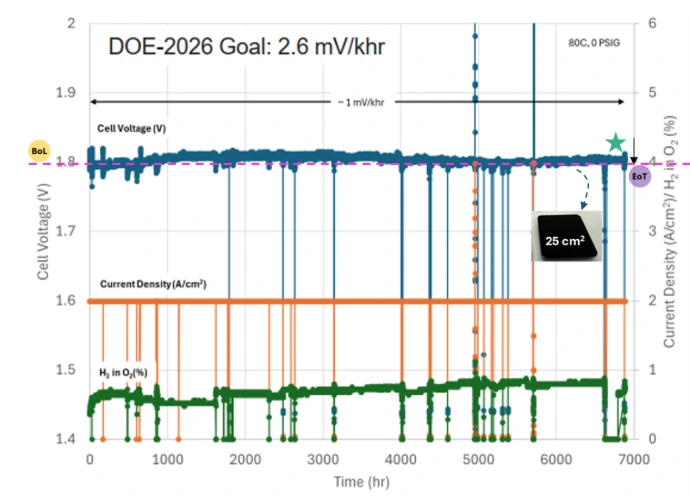
Long-term stability across 7000 hr tests
This graph presents long‑term durability testing under constant current PEMWE operation. The catalyst layers maintain stable cell voltage over extended operation, with degradation rates below DOE targets.
Constant current density operation
Stable cell voltage over an extended time
Better durability than DOE target (~1.0 mV/khr)
These results indicate reliable long-term operation and stable performance under realistic PEMWE conditions.
CLEANHYPRO: Scaling ultra-low iridium catalyst layers
CLEANHYPRO is a European collaborative project focused on accelerating the industrial production and validation of advanced electrolysis materials.
Within the project, VSPARTICLE is developing and scaling a pilot production line for solvent-free deposition of ultra-low iridium catalyst layers directly onto PEM electrolyzer components.
Project key objectives
Enable high-performance catalyst layers with 0.1 mg/cm2 loading
Small nanoparticle size and controlled porosity to maximize active surface area and catalyst efficiency
Maximize utilization of iridium through efficient generation and recovery of nanoparticles
Establish a scalable pathway from research to industrial manufacturing
In June 2026, VSParticle reached a major milestone with the production of the first large size 30 × 30 cm catalyst layer at 0.1 mg/cm2 iridium loading using the newly operational pilot line.
De Nora: Stability test across 500hrs
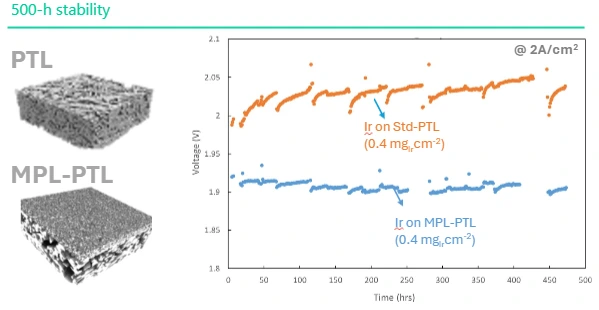
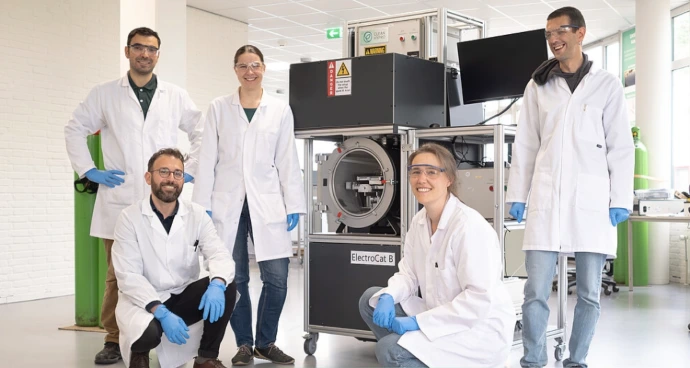
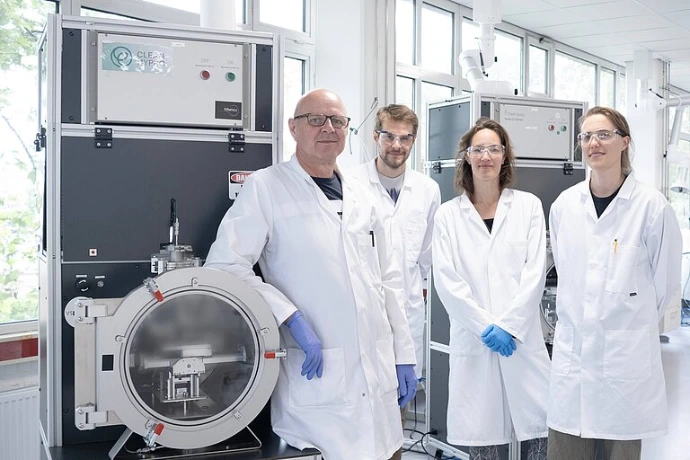
In collaboration with De Nora, a global leader in electrochemical technologies, single-cell testing was conducted to validate performance at ultra-low iridium loading.
The graph highlights 500-hour stability testing of ultra-low iridium catalyst layers under industrial PEMWE conditions.
- Stable operation at ~2 A/cm²
- Consistent voltage profile over time
- No visible degradation
- No performance loss after durability testing, with a slight improvement observed
The Iridium bottleneck: use less, recycle more
Iridium is scarce, expensive and sourced from a highly concentrated supply chain. High catalyst loadings increase stack cost and limit the scalability of PEM electrolysis. Recycling is also difficult when iridium is mixed with binders and ionomers.
VSPARTICLE addresses both challenges through a dry, binder-free deposition process that produces highly porous catalyst layers at ultra-low iridium loadings. This improves catalyst utilization, reduces material demand and keeps iridium more accessible for recovery and recycling.
The scale-up challenge of catalyst-coated membranes
As PEM electrolyzer active areas grow and membranes become thinner, CCM production becomes harder to control. Large, flexible membranes are difficult to coat and handle without wrinkling, stretching or damage, while liquid catalyst inks can cause swelling and dimensional changes that affect coating uniformity.
VSPARTICLE enables depositing binder-free iridium nanoparticles directly onto the Porous Transport Layer (PTL). The PTL provides a stable surface for uniform coating, supports lower iridium loading, easier component handling and more scalable electrode manufacturing.
Ready to scale low-iridium PEM electrodes?
We offer solutions to PEM electrolyzer developers and stack manufacturers to reduce iridium utilization, improve catalyst efficiency, and scale advanced electrode production through a dry, binder-free deposition process.
Our offering includes:
Custom catalyst-coated PTLs for performance and durability testing
R&D systems for in-house catalyst and layer development
Process development and pilot-scale production of large-format components
From early material development to industrial validation and manufacturing scale-up, we provide the technology and expertise needed to bring low-iridium catalyst layers into production.